Florence’s Le Murate: how do you read a place with several lives?

At Le Murate, the interesting question is not simply whether a building is old or new. It is how a place can retain difficult history while being used for something else. This part of Florence rewards a visit that alternates between architecture and current cultural activity. Look at the spaces, read the institution’s account and then leave room for whatever programme is actually taking place. A reused building is more than a backdrop for a photograph.
Begin with a few reliable coordinates
MAD’s own introduction places the municipal complex between Via Ghibellina, Via dell’Agnolo and Viale della Giovine Italia. It describes a former fifteenth-century convent later used as a prison from 1883 to 1985. Piazza delle Murate and Piazza della Madonna della Neve, divided by Via delle Vecchie Carceri, help you understand the arrangement before entering a specific cultural space.
Keep the exterior walk and an interior visit as separate parts of your plan. An accessible square does not establish that every doorway is open, and a programme listing does not necessarily grant entry to every part of the complex. Look for the correct entrance and current instructions. If a space is closed, the honest response is to return at the right time, not to follow somebody through a door that happens to open.
What can the fabric tell you?
Try observing a repeated feature: a line of windows, a doorway or a change in the scale of an opening. Then ask what it allows you to infer, and where you need documentation. A grille may suggest restriction, but its appearance alone cannot tell you who occupied the room, when it was installed or what happened there. The distinction matters particularly in a place associated with confinement.
There is no need to turn a thoughtful visit into a theatrical experience of somebody else’s suffering. Avoid playful prison poses or captions that reduce the site to a novelty. If historical interpretation is available, give it time. Reading one account carefully is more valuable than collecting a set of dramatic textures without understanding their context.
Notice what people make here now
MAD describes its work through exhibitions, performances, workshops, research and artists’ residencies. The programme is part of the reason to visit, rather than a decorative extra attached to the architecture. Consult the current calendar and choose one activity or exhibition that interests you. Dates, participation conditions and room access belong to the particular listing; an old page in the archive is not evidence that an event continues.
When looking at contemporary work, start with a straightforward question: what is the artist asking you to notice? It may involve a material, a sound, a repeated action or your position in a space. You do not have to produce an instant interpretation. Separate a description of what is present from your possible explanation, and allow the latter to change as you read or listen.
Give the visit a sensible scale
As checked on 18 October 2026, MAD lists ordinary opening from Tuesday to Saturday, 14:30–19:30, with last entry at 19:00 and holiday closures. Sunday and Monday are closed under that regular schedule. Special activities can have their own arrangements, so confirm the actual date before setting out. This is an afternoon cultural stop to plan, not an automatic morning museum addition.
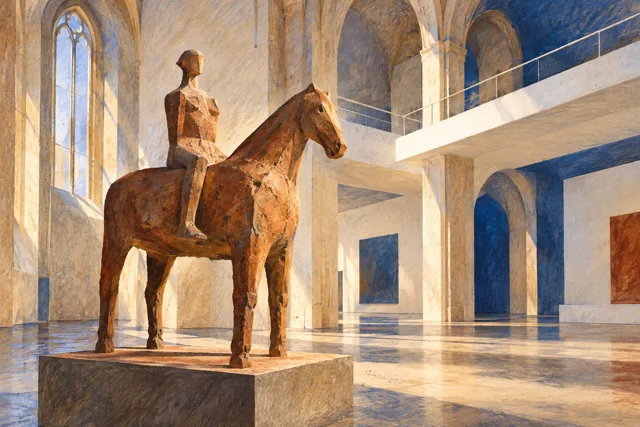
One exhibition and a careful exterior look can make a satisfying visit. Allow a pause before adding another collection. Our Museo Novecento introduction offers another route into modern Florence, while looking at sculpture in the Museo Marino Marini develops the idea that your movement changes an artwork’s effect. Both are separate institutions with their own access arrangements.
Use comparison carefully
Casa Buonarroti’s relationship between a building and remembered lives provides a different Florence question. In Rome, the later lives of the Baths of Diocletian show how another place resists a single-period description. Neither comparison makes the histories equivalent. It simply encourages you to ask what a current use preserves, reveals or leaves less visible.
Explore our Florence arts and events collection if you would like another cultural experience, checking its venue, date and inclusions individually. At Le Murate, aim to leave with two observations: something you learned about the place’s past and something you encountered in its present. Keeping both in view is a richer way to understand reuse than deciding that an old building has merely been given a new coat of paint.
Sources & further reading
Turn a good read into a great day.
Find a highly rated Florentine experience that brings these stories to life.
Explore related experiences →