Florence’s Fondazione Salvatore Romano: what can a collection of fragments reveal?

A fragment can be an excellent travelling companion. It asks you to look closely, admits that something is missing, and leaves room for a question. At Florence’s Fondazione Salvatore Romano, sculptures and architectural pieces occupy the former refectory of Santo Spirito. The visit works especially well if you arrive without expecting a procession of complete masterpieces. The spaces between objects are part of the experience too.
Understand whose collection you are entering
Salvatore Romano was an antiquarian and collector who donated this group of works to Florence in 1946. The city’s account traces his journey from Meta di Sorrento through Naples to Florence and describes a particular interest in sculpture and carved stone. The official ticket page explains that the arrangement still follows the display he devised. A donation transferred ownership, but the collector’s choices continue to shape the encounter.
That is a useful distinction from a collection assembled to represent every period evenly. A room can be coherent because someone selected and arranged its contents, even when those contents come from different places and dates. Our Museo Stefano Bardini guide offers another Florentine example of this question. Compare the methods of display rather than trying to decide which collector had the more impressive taste.
Let the room remain a room
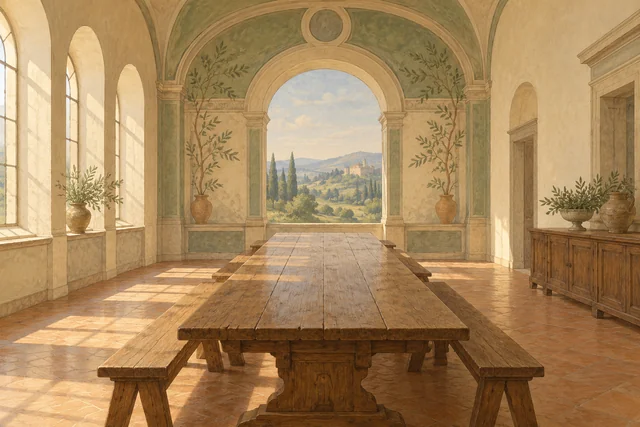
The official civic museum description identifies the setting as a medieval monastic refectory and points to a large fourteenth-century fresco by Orcagna recalling that earlier function. Before moving between objects, take a moment to consider the proportions of the hall. Where does your attention travel first? How does the wall painting affect the scale of the works below it? These are observations you can make without confusing the collection’s arrival with the building’s original use.
The adjacent basilica is a separate visit with its own conditions. Do not assume that a collection ticket includes every church space or that a guided activity advertised for the complex is happening when you arrive. Our Brancacci Chapel article can help you plan another focused Oltrarno art visit, but combining nearby places still requires checking their individual arrangements.
Start at a broken edge
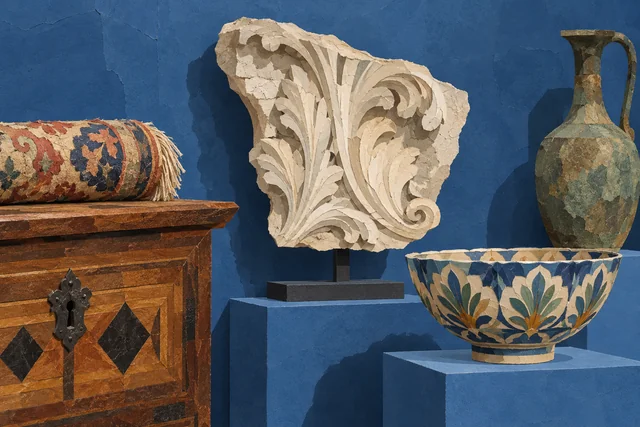
Choose a fragment that can be seen clearly from the visitor route. Look first at the carved surface, then at the edges where it ends. Does the surviving piece suggest that something once continued beyond it? You may be able to recognise a leaf, a fold or part of a figure without knowing the complete original composition. Hold those two levels of knowledge apart. Recognising a motif is not the same as reconstructing a lost object.
Next, read the label for material, date and provenance. The city explicitly notes that the stated origins generally follow information Romano supplied at the time of donation. That is valuable documentation, and it is also a reminder to notice how knowledge has been transmitted. If an attribution is qualified, keep the qualification when discussing the work afterwards. A carefully preserved uncertainty is more useful than an invented confident story.
Compare surfaces without ranking them
Pick a second object that handles light differently. A broad plane, a deeply cut hollow and a worn projecting edge can each catch your attention in a different way. Describe the effect before deciding whether you prefer one. A fragment can be expressive because of what survives and because of how the museum positions it; those are related but distinct explanations.
For another intimate encounter with collecting, our Museo Horne guide changes the scale from a large hall to a domestic setting. If your trip extends to Rome, the Palazzo Altemps collection guide offers a further comparison in the display of sculpture. Use the connection as a question to carry between cities, not a reason to rush through either place.
Give the calendar as much attention as the map
The current official schedules, checked on 24 October 2026, list opening on Monday and Saturday, with a shorter Sunday afternoon window. This is not a museum to assume will be open on any weekday. Official pages currently show differing admission prices, so consult the current ticket checkout or museum directly instead of building your budget around an older quoted figure. Confirm any special access requirements before travelling.
Our Florence art experiences can help compare guided options, but check the actual inclusions and whether an advertised activity requires a separate reservation. Once inside, you can keep the plan pleasantly small: one room, two fragments and one question about where they came from. The collection rewards that degree of attention without requiring you to pretend that every gap can be filled.
Sources & further reading
Turn a good read into a great day.
Find a highly rated Florentine experience that brings these stories to life.
Explore related experiences →