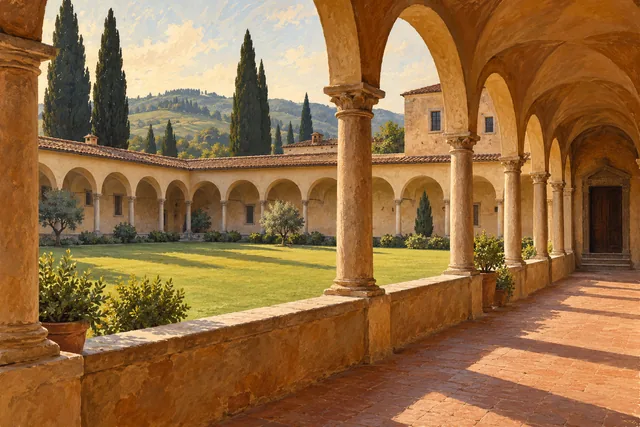
Florence’s La Petraia: how should you separate a villa visit from garden time?

La Petraia rewards a visitor who thinks in two rhythms. The garden invites you to look, pause and change direction; the villa interior follows accompanied entry times. Planning one as if it worked like the other can turn a promising outing into a wait at the wrong door. Begin with the actual visiting arrangements, then let the setting provide the pleasure. This is a trip to the Castello area of Florence, not another room reached by stepping out of the Uffizi.
The name also belongs to a wider network of Medici villas and gardens. That network is an institutional and historical relationship, not one continuous attraction. Our Castello garden guide covers a nearby but separate site. If you want to combine them, confirm the access and ticket conditions of both rather than treating their proximity as a guarantee of a seamless route.
Make the interior appointment the fixed point
The Ministry of Culture page checked on 23 October 2026 lists accompanied villa entry at specific times. For October and March, it gives turns at 9:30, 10:30, 11:30, 12:30, 14:00, 15:00 and 16:00, with a maximum of 25 people. The page lists the visit as included in the admission ticket. Confirm the current arrangements before travelling, especially if your party needs certainty about a particular turn or assistance with access.
Build travel time around that fixed point. A garden opening time is not a promise that the villa doors admit independent visitors continuously. Nor should a timetable be read as live availability for your group. If you arrive early, ask staff how the visit operates that day. Having a clear question ready is more useful than assuming that a timetable found elsewhere applies unchanged.
Distinguish the garden from the upper park
The same official page currently says that the park is temporarily closed for safety works while the garden remains open. Keep those two areas separate in your expectations. A photograph of wooded paths or a general description of a landscaped park does not establish current access. Weather alerts can also affect outdoor areas. This is a particularly good place to read the notice as part of the itinerary, not as small print added after the plan is finished.
The garden’s terraces can still invite a focused way of looking. Notice how a level change alters the relationship between plants, paths and the building. Choose a permitted stopping point and compare a close detail with the larger arrangement. Avoid turning formal planting into a checklist of species unless current labels support the identification. Our Boboli landscape guide offers another set of looking questions, while describing a different garden and its own visiting conditions.
Read a residence with more than one period
Regione Toscana traces La Petraia from an earlier fortified property through Medici ownership and transformation, then through later changes. Its account describes the nineteenth-century conversion of the courtyard into a ballroom under an iron-and-glass covering. That history is a useful antidote to the assumption that a Medici villa must preserve a single, entirely sixteenth-century interior. Look for the explanations that identify when different features entered the building’s story.
A room can tell you about its architecture, its decoration and the way it has subsequently been furnished or displayed. These layers need not agree in date. When something appears stylistically different from its surroundings, treat that as a reason to read the label or ask a question. It may be a clue to a later residence rather than a mistake in your understanding of an earlier one.
Look at images of villas as images
La Petraia is also associated with the surviving lunettes by Giusto Utens representing Medici villas, which the Ministry records as displayed at the villa. Such pictures offer an engaging comparison with a real landscape, but they are composed representations. Ask what is made prominent, how the site is organised on the surface and what the chosen viewpoint lets a viewer understand. Do not treat a historical image as a current walking map or proof that every depicted detail survives.
For a broader collecting context, our article on Medici collecting can help you frame questions before the visit. If another city is on your itinerary, Rome’s Villa Farnesina guide considers a separate relationship between a residence and its painted spaces. Comparing the questions is fruitful without merging the histories.
Leave enough flexibility for the real route
Accessibility deserves a direct check with the venue: the Ministry identifies limits to the areas visitable by disabled visitors and difficulty in the garden. Ask about your particular needs rather than relying on the word “garden” to suggest a flat route. Bring a plan for the return journey and avoid placing a tight city-centre booking immediately afterwards. The point is to enjoy a distinct setting, not win a scheduling contest.
Our Florence day-planning experiences can help compare other ways to organise time outside the most concentrated centre. Check each itinerary’s departure point and actual inclusions. For La Petraia itself, the satisfying combination is precise and unhurried: a confirmed interior turn, only the outdoor areas currently permitted, and enough attention to recognise that the villa’s history continued long after its Medici chapter.
Sources & further reading
Turn a good read into a great day.
Find a highly rated Florentine experience that brings these stories to life.
Explore related experiences →