Florence paper marbling: what should you ask before a workshop?

A sheet of marbled paper is a small, portable reminder that Florence makes things as well as displays them. Swirls and combed patterns can look effortless when an experienced craftsperson demonstrates them. A visitor’s workshop invites a more interesting discovery: how much attention lies behind an apparently spontaneous result. Before booking, establish what you will actually do. Watching a demonstration, decorating a sheet and binding a notebook are related experiences, but they are not interchangeable descriptions.
Start with the finished object you hope to make
One useful local example is Il Papiro’s published workshop programme. It distinguishes a demonstration from assisted paper marbling, and from marbling combined with bookbinding. Its description includes taking away the decorated sheet or the notebook made with it, depending on the activity. Treat that as a prompt for questions rather than a promise about every Florence class: what is included in this specific booking, what does each participant make, and which parts are demonstrated by the teacher?
If your ambition is a first experiment with color, an assisted sheet may be satisfying. If the finished notebook matters most, ask how much binding participants complete themselves and what preparation has already been done. Neither approach is inherently better. A short introduction and a longer craft session serve different visitors. The important comparison is between the advertised process and your expectations, rather than between photographs of impossibly perfect finished work.
Ask how participation works for your group
Find out whether each person has time at the tray or whether tools are shared in turns. Ask about the language of instruction, the maximum group size and whether accompanying adults are participants or observers. For children, confirm the actual minimum age and the adult supervision expected. A class described as suitable for beginners does not automatically suit every age, attention span or physical need.
Describe any access requirement in practical terms: whether you need to work seated, avoid prolonged standing, reach the surface from a wheelchair or receive instructions in an alternative format. Ask what materials are used if a sensitivity affects your plans. These are useful booking questions, not reasons to assume that a particular workshop cannot accommodate you. An accurate reply from the host is more valuable than guessing from the word “creative.”
Allow time for the object after the activity
Ask when your paper will be dry enough to pack, whether protective packaging is provided and whether collection later in the day is necessary. Check the size of the finished piece against the bag you are carrying. A sheet you love deserves better than being folded between a water bottle and a damp umbrella. If you have a train shortly afterward, make the collection arrangements explicit before paying.
A workshop also needs some breathing room around it. Check the exact address rather than assuming it takes place inside the shop where you first saw the paper. Leave time to arrive and settle in. Our slow Oltrarno walk can inspire a gentler part of the day, but map the actual workshop location before combining the two. Not every craft business is in the same neighborhood.
Enjoy the craft without inventing a timeless story
Il Papiro’s own history dates the company’s establishment in Florence to 1976. A living craft business can draw on older techniques while also having a modern history. That distinction is worth keeping: “traditional” does not mean that a shop, tool or product has remained unchanged for centuries. Ask the maker what they learned, what they have adapted and how they judge a successful sheet.
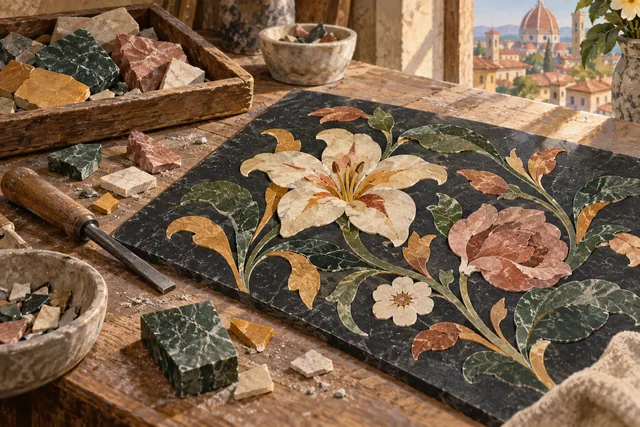
You might notice rhythm before technical perfection: a sequence of narrow lines, an unexpected patch of color or an edge where the pattern changes. Choose one thing to remember about the process as well as the souvenir. Our article on pictures made from stone at the Opificio offers another Florence encounter with patient material choices. For a different craft city, Venetian glass beads show how small objects can support large questions about skill.
Book the experience, not just the appealing image
Compare the duration, participation, materials, cancellation rules and meeting instructions before choosing. Browse Florence experiences for your dates, or consult a workshop directly when it is not in the collection; a general craft or walking listing should not be treated as a marbling reservation. If your group prefers making something edible, our guide to choosing a Florence cooking class raises similarly useful questions about hands-on time. Pick the activity whose process you want to enjoy, and let the finished object carry the memory home.
Sources & further reading
Turn a good read into a great day.
Find a highly rated Florentine experience that brings these stories to life.
Explore related experiences →