How Did Brunelleschi Build Florence’s Dome?
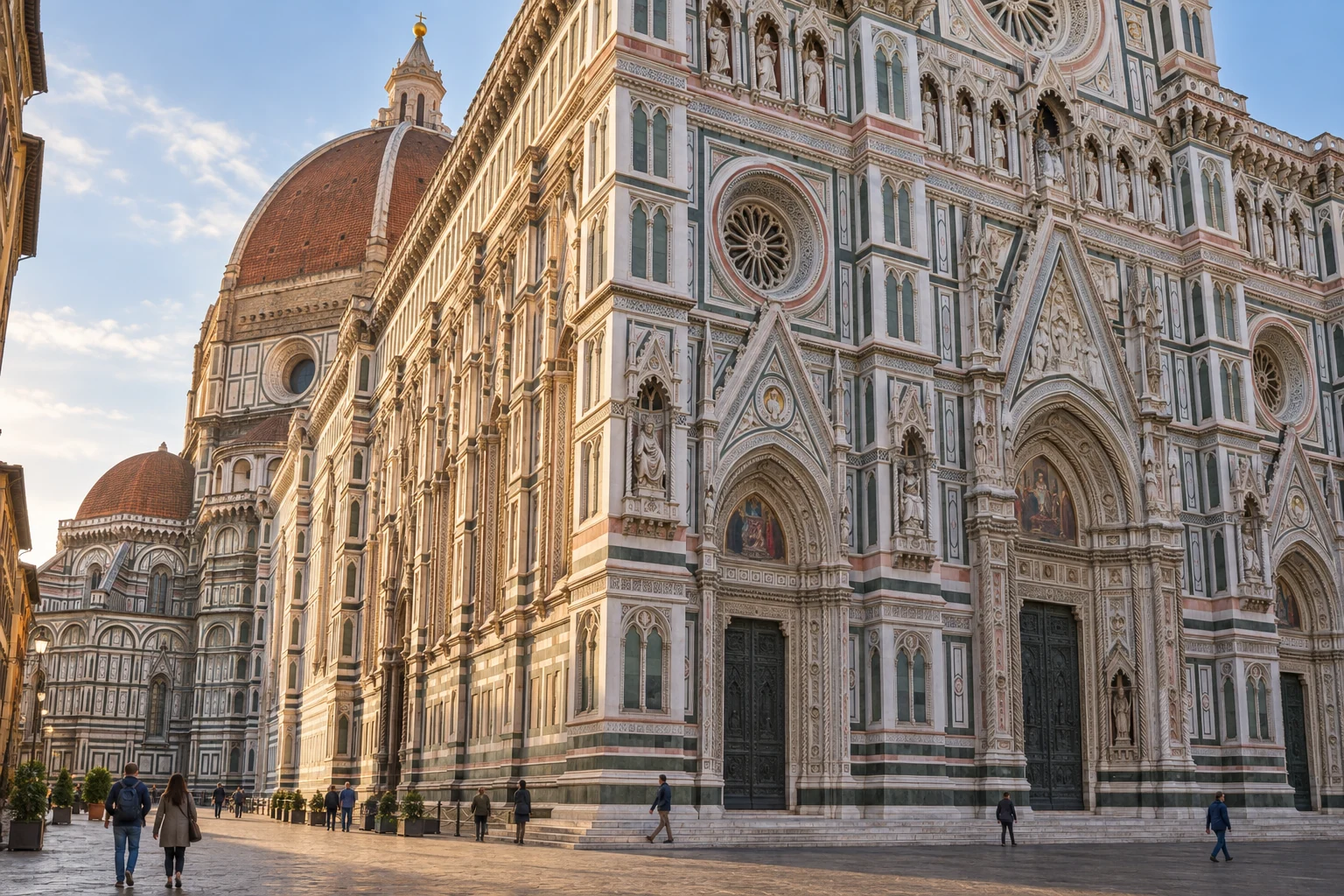
Look at Florence’s skyline for long enough and the dome stops behaving like a background. It becomes a question. How did builders raise so much masonry over such a wide space, centuries before modern cranes and concrete shells? The answer involves geometry, materials, organization and a remarkable designer. It also involves many skilled workers whose labor is easier to overlook than the spectacular shape they created. A useful introduction starts with the problem rather than a legend about solitary genius.
The cathedral needed an extraordinary roof
The cathedral was already a long-running civic and religious project when Filippo Brunelleschi’s solution took shape. Construction of the dome ran from 1420 to 1436. Its great challenge was spanning the opening without the enormous conventional wooden support framework such a vault might seem to require. The official Opera del Duomo account emphasizes this achievement: the structure could be raised without a timber reinforcement system capable of filling and supporting the whole vast space below.
Think of the building site as a sequence of decisions. Materials had to reach the workers, courses had to remain stable as construction advanced, and people had to coordinate at considerable height. Even without understanding every technical debate, you can appreciate that the finished silhouette conceals a disciplined process. The dome was not imagined once and then simply stacked into existence. It had to be buildable at every stage, not merely convincing in a drawing.
Two shells make a different kind of space
The dome has inner and outer shells, linked by structural ribs, with a passage between them. Its octagonal form and visible white ribs make the shape readable from outside. The terracotta surface is therefore only part of the story. The internal organization matters as much as the appearance that has become Florence’s emblem. If you have a suitable climb booking, the route offers a different sense of the building’s thickness and construction from a distant skyline view.
The famous herringbone brick pattern is one of the details discussed in accounts of the engineering. Resist turning that detail into a magic trick that explains everything by itself. A large structure works through relationships: form, masonry, supports and construction sequence. On a guided visit, a productive question is “What can we actually observe here?” It encourages an explanation grounded in the building rather than a performance of impressive but disconnected numbers.
Look from below before going above
Begin in the square or on a nearby street where you can see the drum beneath the dome. Follow one rib upward with your eyes. Notice how the curved surface gathers toward the lantern and how the dome relates to the rest of the cathedral. Then step back, safely out of the flow of pedestrians, and compare the scale with surrounding roofs. You have just performed a small architectural study without needing a technical vocabulary.
If you enjoy this way of looking, use our history collection to find experiences with room for explanation. Read the itinerary carefully: a cathedral-quarter walk and a dome climb can both teach you something, but they use time differently. The former may provide better external viewpoints and context; the latter places more attention on the physical route. Neither is automatically the superior choice for every traveler.
Separate construction from decoration
The architecture and the imagery inside the dome belong to different moments. The enormous Last Judgment fresco was painted later by Giorgio Vasari and Federico Zuccari. That distinction is useful because a historic building is rarely one frozen creative act. Structure, decoration, repair and visitor access accumulate over time. Asking “Which period am I seeing now?” can turn an apparently overwhelming monument into a sequence of understandable choices.
Florence offers this layered reading everywhere. The cathedral facade itself is a later chapter than the medieval building behind it. A visually harmonious ensemble does not necessarily share one date. You can carry the same habit into a first encounter with Renaissance art: identify the object, notice the evidence, then use a reliable explanation to test your initial impression. Curiosity works better than trying to memorize every name at once.
Bring a question home
Before leaving, decide which aspect interested you most: how the materials were lifted, how the shells work together, or how a city committed itself to such an ambitious project. That question can guide further reading long after the trip. A good architectural visit does not end with the feeling that everything has been explained. It leaves you with a clearer view of the achievement and a more precise reason to keep looking.
For another perspective, continue with How to Look at Renaissance Art Without an Art History Degree. It connects this visit with a different part of Florence and can help you choose what to give your time to next.
Sources & further reading
Turn a good read into a great day.
Find a highly rated Florentine experience that brings these stories to life.
Explore related experiences →