How to Look at Renaissance Art Without an Art History Degree
You do not need an art-history degree to have a rewarding encounter with Renaissance art. You need time to look, permission to ask a basic question and a reliable source when you want to understand the context. Florence can make that sound harder than it is because the names are so famous. Try setting the fame aside for the first minute. An artwork is an object made of materials, organized in a particular way, and placed before you under particular conditions.
Begin with what is visible
Choose one work and describe it in ordinary language. How many figures are present? Where is the brightest color? What seems near and what seems far away? Does a gesture direct your attention toward another person or an empty space? These are not elementary questions to get through before the “real” interpretation. They are the evidence on which a useful interpretation can be built. Looking carefully is already a serious way of engaging with art.
Then read the label or listen to a trusted explanation and look again. Notice which part of the information changes what you see. A title may identify a story, a date may place the work in relation to another, or a material may explain a surface. You do not need to retain everything. One piece of context that sharpens your attention is more valuable than ten facts that leave the object itself unnoticed.
Follow a line or a gesture
In a painting, choose a visible line and see where it leads. It might be the edge of a garment, a piece of architecture or the direction of a person’s arm. In Botticelli’s Spring, the museum’s account identifies mythological figures, but you can also notice the rhythm of their placement and the flowing outlines. A composition often guides the eye through relationships long before a viewer has learned every figure’s name.
Try the same exercise with sculpture. Move when the setting allows and observe how one viewpoint becomes another. A hand that appears detached from the body at one angle may align with it at another. Respect barriers and other visitors, and avoid assuming there is a single correct spot from which every work must be seen. Part of the pleasure is discovering how the object changes as you change position.
Ask what the material makes possible
Marble, bronze, wood and painted surfaces do different things with light. Look for polish, texture, thin edges, deep shadows or the transition between flat and modeled areas. You do not need technical expertise to notice the effect. If a guide explains a process, connect the explanation to something visible rather than treating the technique as another word to memorize. Materials can make artistic decisions tangible in a way that a biography alone cannot.
The cathedral quarter offers a useful reminder about preservation and display. The official Baptistery information explains that its original bronze doors are preserved in the Opera del Duomo Museum. A work’s current location may therefore differ from the setting for which it was made. Asking where an object originally belonged helps you understand scale, viewpoint and purpose, while appreciating why conservation may require a different arrangement today.
Compare two works with one question
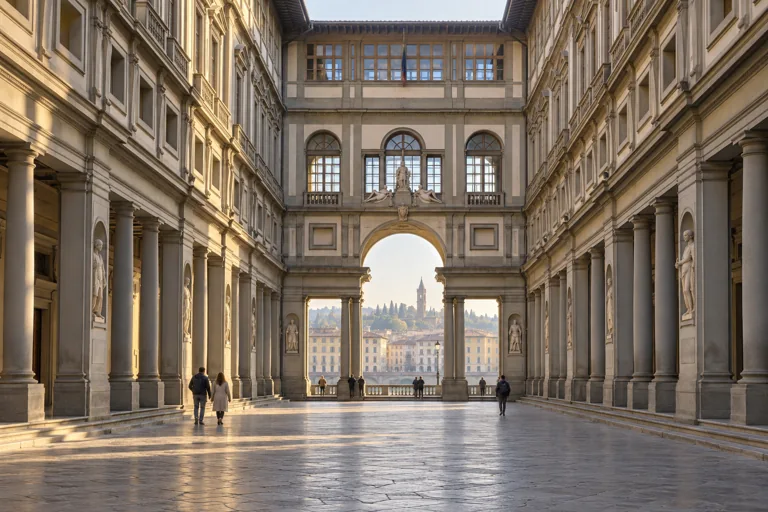
Do not attempt to compare everything at once. Choose one problem: how two artists suggest distance, how two faces convey attention, or how two rooms present sculpture. This gives a visit structure without turning it into a test. Our Uffizi guide suggests a focused first route, while the Accademia introduction emphasizes moving around sculpture and noticing the surrounding collection.
Be comfortable with uncertainty. “It seems to me” is a useful phrase when you are describing a response rather than asserting a historical fact. You can enjoy a work before fully understanding its subject, and you can understand its importance without personally loving it. A thoughtful visit makes room for both reactions. The aim is an attentive relationship with art, not agreement with a universal ranking of masterpieces.
Let an informed guide deepen the encounter
If you enjoy discussion, compare guided art experiences with a clear focus and a duration that suits you. Ask questions grounded in what you can see. A good explanation should make the artwork more available to your attention, not replace it with a stream of names. After the visit, choose one object for further reading from the museum’s own collection resources. That small continuation turns a holiday encounter into the beginning of a durable interest.
Sources & further reading
Turn a good read into a great day.
Find a highly rated Florentine experience that brings these stories to life.
Explore related experiences →