Santa Croce: Art, Memory and a Living Church
Santa Croce can be introduced through famous names, but a list of memorials is only one way into the church. It is also a Franciscan religious place, a setting for painting and sculpture, and a building altered by changing needs over centuries. A rewarding visit allows those identities to coexist. You can be interested in art without forgetting worship, and interested in celebrated individuals without reducing the entire complex to a hall of fame.
Begin outside with the square
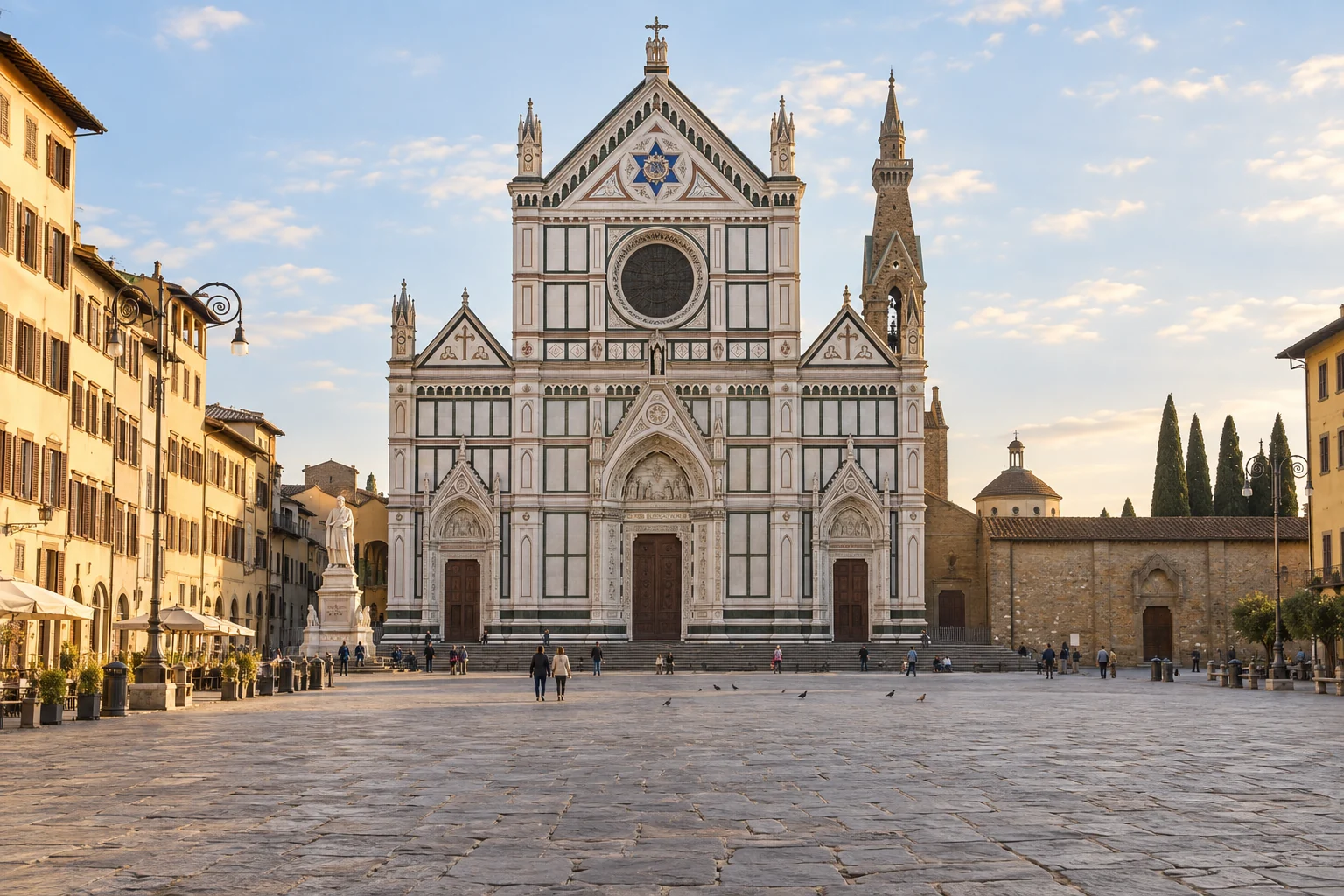
Before entering, spend a few minutes noticing the broad piazza and the church’s relationship with the surrounding buildings. A facade is both an entrance and a public face. Look at its patterns, its scale and the way it changes as you move away from the centerline. This is a simple way to slow the pace after navigating the streets. It also provides a useful visual memory to compare with the interior later.
The official history connects Santa Croce with the arrival and growth of the Franciscan community in Florence. Its account places that story within a city shaped by work, expanding neighborhoods and religious life. You do not need to absorb every phase before visiting. Keep one broad question in mind: how did a community use architecture and images to communicate with people who entered this space?
Notice how the church tells stories
Inside, look at the relationship between the main space and its chapels. A painted cycle is different from a single picture hung on a neutral wall: images speak to one another and to the architecture that contains them. Begin with a visible gesture, a repeated figure or the division of scenes. If you have a guide, ask how the sequence is meant to be read rather than only asking for the names of the artists.
The church’s official history describes changes to the interior, including sixteenth-century interventions associated with Giorgio Vasari. That is a reminder that what you see is layered. An old building can contain alterations that deliberately change how earlier spaces function. Resist the idea that one period is the only “authentic” church and everything else is an interruption. The history includes adaptation, preservation, loss and renewed use.
Read memorials carefully
A memorial can honor someone without containing that person’s remains. This matters particularly when travelers move quickly from one famous name to the next. Read the label or reliable explanation before describing every monument as a tomb. Dante’s connection with Florence, for example, involves exile and later remembrance as well as literary fame. The municipal Dante itinerary distinguishes the commemorative material within the city from the events of his life.
Ask what a monument says about the people who commissioned it, not just the person it names. Which qualities are being celebrated? How does the design invite attention? A memorial belongs to the period that created it as well as to the life it recalls. This is one reason a church can become a place of collective memory without being a simple chronological biography of everyone represented inside.
Make the visit respectful and comfortable
Check the official opening arrangements, admission information and any current limitations before arriving. Follow dress and behavior requirements, keep voices low where appropriate, and observe photography rules. If a service or other religious activity affects your route, treat that as part of the building’s living purpose. A visit is not made less meaningful by remembering that the place has responsibilities beyond receiving tourists.
Allow a manageable amount of time and choose a few areas for close attention. Our history experiences can help you find guided context, while our Florence essentials collection supports the practical side of planning. Check whether an experience includes entry, exterior commentary or a larger walking route. Those are distinct offers, even when the same landmark appears in their titles.
Carry the question beyond the doorway
Afterward, pause in the square and think about which layer stayed with you: a painted story, a monument, the scale of the nave or the evidence of changing use. If your trip continues to Rome, Rome Tour Hub offers another setting for exploring how religious buildings and civic memory overlap. The comparison is most useful when it begins with observation rather than an assumption that every Italian church tells the same story. Santa Croce has its own community, history and physical presence, and your visit becomes richer when you give those differences time to emerge.
For another perspective, continue with How to Look at Renaissance Art Without an Art History Degree. It connects this visit with a different part of Florence and can help you choose what to give your time to next.
Sources & further reading
Turn a good read into a great day.
Find a highly rated Florentine experience that brings these stories to life.
Explore related experiences →