Santa Maria Novella beyond the railway-station name
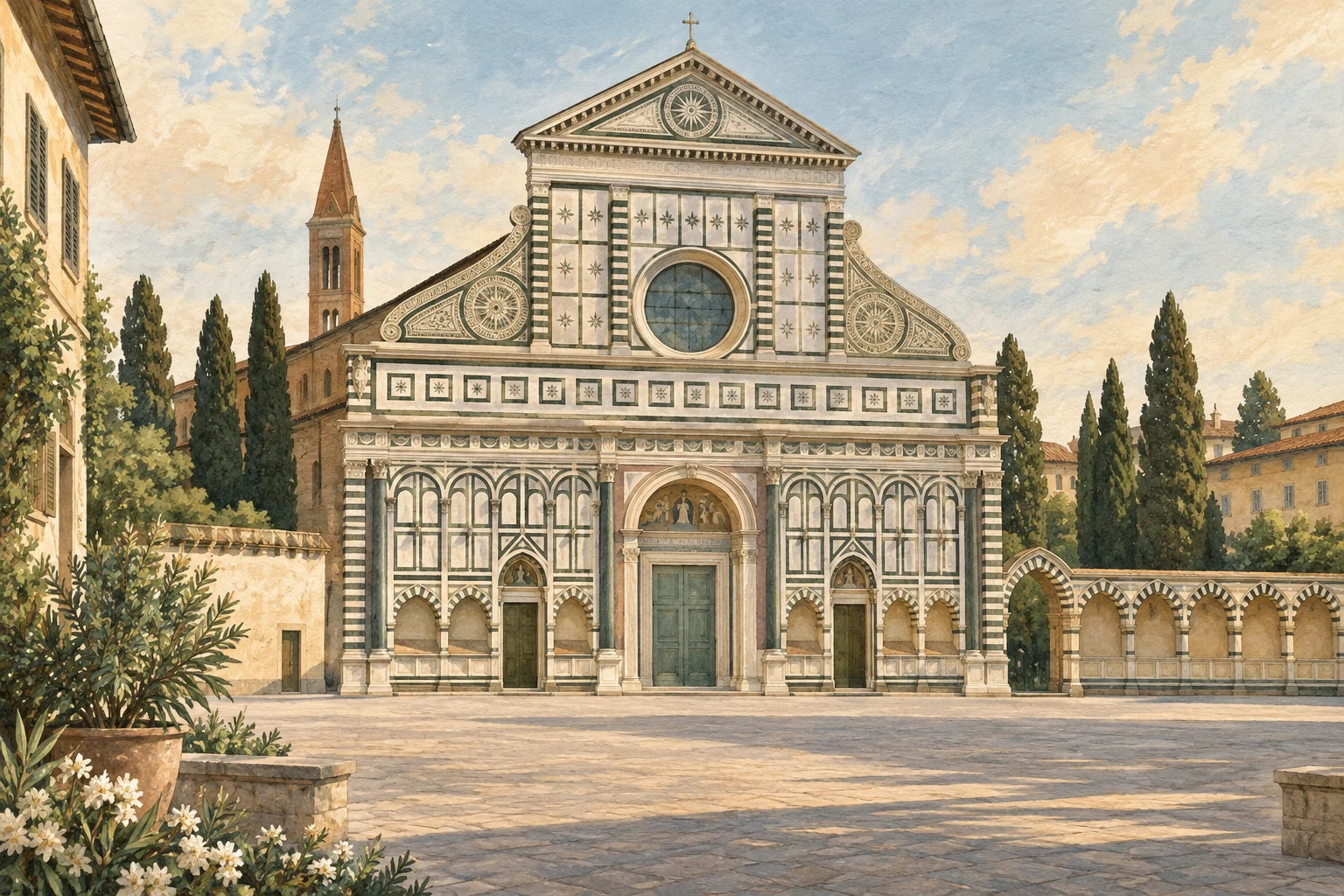
Santa Maria Novella is easy to reduce to a transport label: the name on a train booking, a meeting-point instruction or a hotel search. Give the church its own place in your Florence visit and the name becomes much richer. Its facade presents an exercise in architectural order, while the interior asks you to think about painting as part of a religious building rather than as an isolated museum object.
You can make a satisfying visit around two ideas: how older and newer parts form one facade, and how a painted surface creates the impression of depth. Neither requires an art-history examination. If you would like a general method first, read our introduction to looking at Renaissance art, then bring those questions to this particular setting.
Let the facade become a problem worth solving
The Opera’s account of the facade explains that Leon Battista Alberti had to work with existing features rather than design on a blank wall. Giovanni Rucellai’s patronage is commemorated with the date 1470. The account also distinguishes that Renaissance phase from later completion work. The building’s apparent coherence does not mean that every visible part was made at one moment.
Stand where you can see the whole facade without blocking the flow across the square. Notice the broad horizontal divisions first. Then trace the relationship between the lower section, the circular window and the upper pediment. How do the curved forms at the sides help your eye move between different widths? Treat this as a visual question before reaching for specialist vocabulary.
Now choose a smaller detail. Does its outline repeat a shape elsewhere? Do the pale and dark stone areas make a surface seem flat or give it depth? Our Florence Cathedral marble guide provides a useful comparison, but the two facades should not be collapsed into one story simply because both use contrasting stone.
Inside, distinguish a real room from a painted one
Masaccio’s Holy Trinity offers a particularly clear subject for slow looking. The church’s artwork guide identifies the fresco in the left nave and discusses its architectural perspective. Look first at the painted structure around the figures. Find an edge that appears to recede and follow it with your eyes. What makes the surface suggest a space beyond the wall?
You do not need to calculate a vanishing point to recognize that something careful is happening. Compare the implied depth of the painting with the actual depth of the church around you. Then look at how figures occupy the painted space. The exercise connects an artistic technique to a visitor’s physical position, making perspective feel less like a textbook definition.
Keep the subject matter present too. This is religious imagery made for a religious environment. Observing the visual structure need not replace attention to its devotional purpose. Read the venue’s interpretation, allow others a clear view and follow current rules for photography and movement.
Read restoration notices as part of the visit
The Opera’s notice announcing completion of the Trinity restoration gives a more current reference than older pages advertising visits to the worksite. That distinction matters when planning: an archived event is not an ongoing ticket offer. Use current visitor notices for access, and treat past restoration coverage as context about the work’s care.
More generally, avoid promising yourself an uninterrupted view of every artwork from a photograph taken years earlier. Conservation, liturgy and visitor management can alter what is accessible. Having two or three questions, rather than one required photographic angle, makes the visit more adaptable without making it less meaningful.
Give the church a realistic place in your schedule
Check the official visitor notices before choosing a time. Religious services can change visiting hours; the page currently includes an early closure on 15 October 2026. Consult the live notice rather than treating this article as a fixed timetable. Confirm which areas your chosen admission or guided experience includes.
If you are arriving by train, allow separately for leaving the platform, storing luggage if necessary and reaching the correct visitor entrance. A church near a station is not automatically a comfortable activity for the few minutes before departure. Our short-visit planning guide helps distinguish time on the clock from time available for looking.
Browse Florence history experiences when you want a guide to develop the subject, checking for an explicit Santa Maria Novella stop. For another city’s approach to art in working religious buildings, read Rome’s church-art guide. A successful Santa Maria Novella visit changes the name from a departure point into a place you can actually describe.
Sources & further reading
Turn a good read into a great day.
Find a highly rated Florentine experience that brings these stories to life.
Explore related experiences →