Why Is Florence Cathedral Covered in Colored Marble?
Florence Cathedral’s colored exterior does more than make an excellent photograph. Its marble patterns belong to a long Tuscan architectural tradition, created from carefully chosen stones and renewed by generations with different ambitions. The short answer to the title question is therefore both practical and cultural: contrasting materials make a huge building visually readable, while the colors connect it to local craftsmanship, religious meaning and civic identity. The longer answer begins with looking at one small panel instead of the entire cathedral at once.
Start with a pattern you can follow
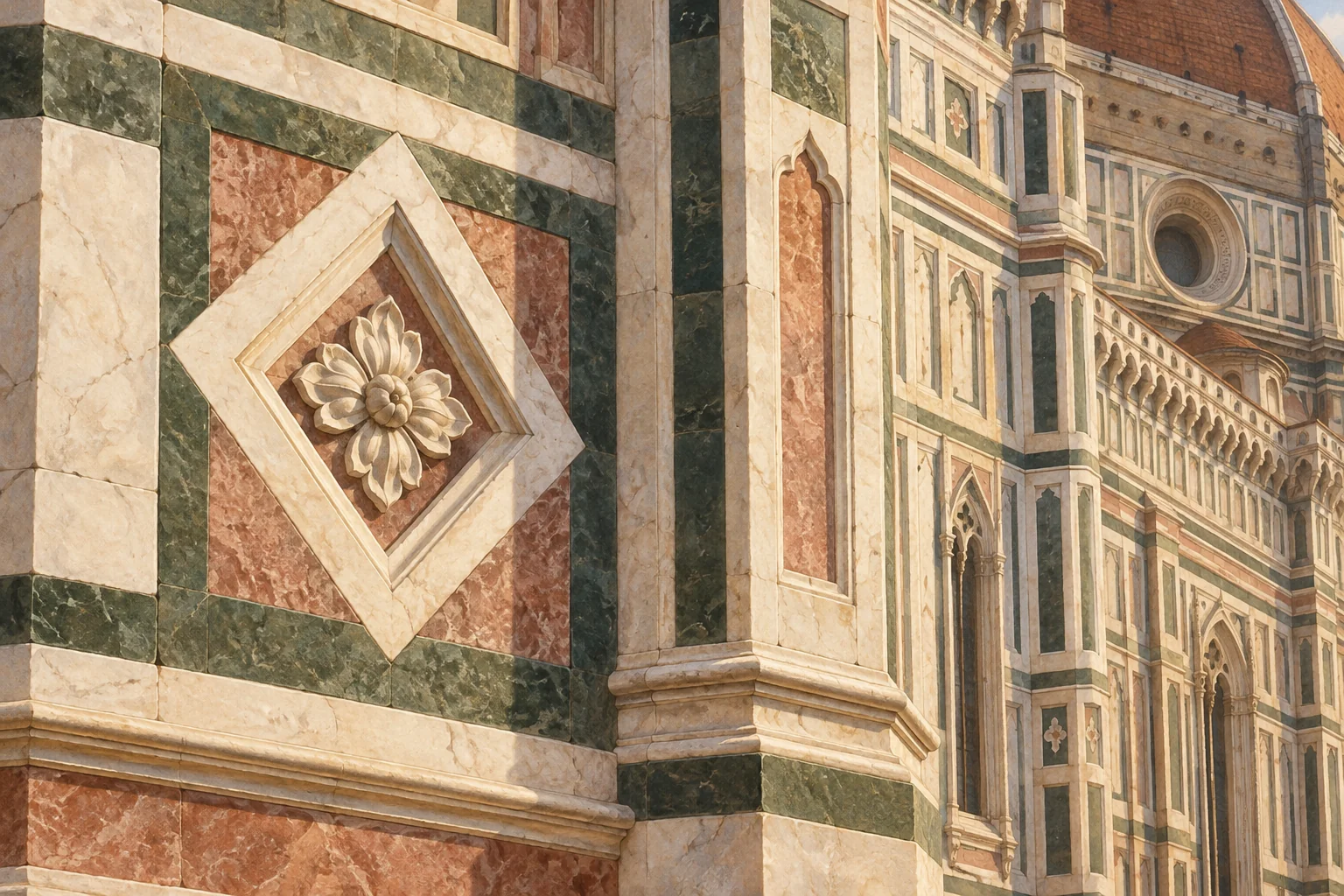
Stand where you can pause without blocking an entrance and choose a rectangle, diamond or strip of dark green stone. Follow its outline into the neighboring panel. Pale borders separate colored surfaces; repeated shapes give the eye a rhythm; carved details interrupt the geometry. These are useful observations before any historical explanation. You can ask whether the pattern emphasizes height, outlines an opening or gathers several smaller features into a larger composition.
The Opera di Santa Maria del Fiore’s cathedral guide identifies the exterior’s white, red and green stone, geometric designs and stylized flowers. Notice that its description says red, although many panels may look pink to you. Light, weathering and differences between stones complicate a simple three-color label. A cloudy morning and warm afternoon can make the same wall feel surprisingly different.
Read the stones as a geography lesson
According to the Opera’s account of the cathedral’s stone supply, the green material is associated with the serpentine quarries of Monte Ferrato near Prato. Red and white stones came from several locations; the building was not supplied by one convenient quarry. The institution describes a supply network crossing territories and changing over time. That makes the facade a useful reminder that monumental architecture depends on transport and procurement as well as design.
There is a further distinction worth keeping in mind: a polished architectural surface is not a geological classification. “Marble” can function as a broad descriptive term in discussions of decorative stone. Looking closely means allowing both the visual unity and the material differences to remain interesting. You do not need to identify every rock correctly to appreciate the decisions required to cut, move and fit it.
One coordinated square, several centuries
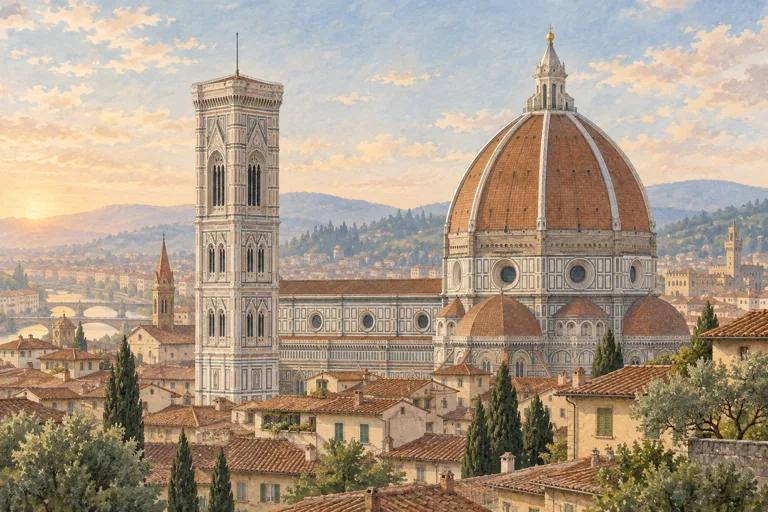
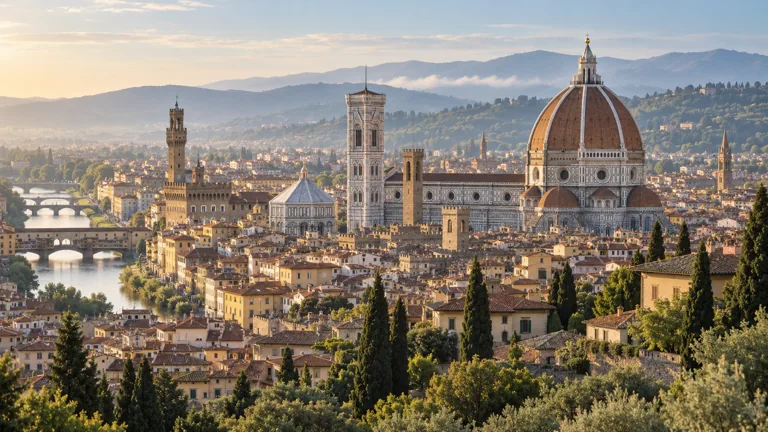
The cathedral, Baptistery and bell tower can initially seem like a single coordinated project. Compare them more patiently. The Baptistery’s strong geometric divisions and the tower’s tall sequence of openings organize similar colors differently. Try sketching only their largest dark and light areas. Even an untidy notebook drawing can reveal distinctions that disappear when every ornament competes for attention.
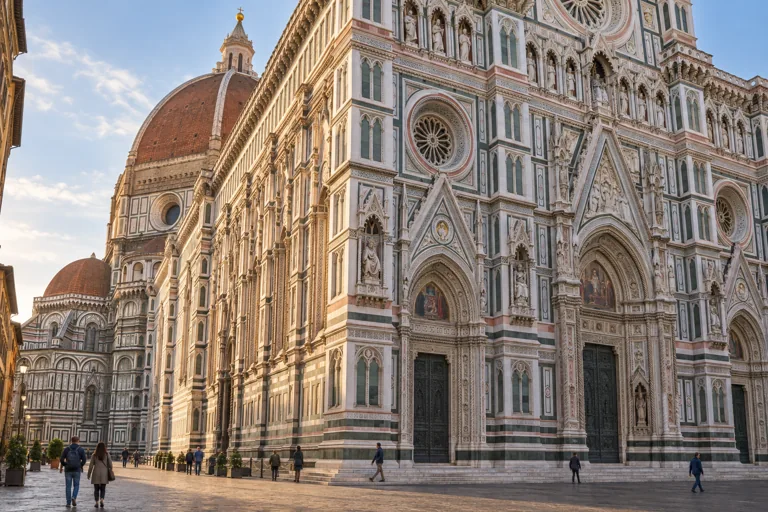
The present cathedral front is much later than much of the building behind it. The Opera’s history of the facade explains the nineteenth-century project associated with Emilio De Fabris and its inauguration in 1887. Its medieval appearance is deliberate. This is not a reason to dismiss it as an inferior afterthought; it is a chance to ask what a later Florence wanted its cathedral to express.
A color can acquire another meaning
The same official history connects the nineteenth-century use of red, white and green with the recently unified Italian nation. That interpretation should not be projected backward onto every earlier piece of stone. A palette established in an older architectural tradition can acquire a new political association when used in a different period. Buildings carry changing meanings without needing to change every material.
This is a useful habit for the rest of your visit. Ask two separate questions: when was this element made, and how might people have understood it later? Our introduction to looking at Renaissance art uses the same patient method. Begin with visible evidence, then let reliable interpretation refine your first impression.
Give the exterior a place in your day
Allow a short, deliberate circuit of the cathedral quarter before joining a scheduled visit. Compare one detail from near the facade with another on a side wall, keeping entrances and walking routes clear. Take a broad photograph and one close detail rather than trying to record every panel. The pair will help you remember how the surface works at different scales.
Our Duomo experience collection can help you find a guided introduction when materials and architectural history particularly interest you. Check whether the itinerary actually includes exterior interpretation: a climb-focused booking may use its time differently. For the structures above these patterned walls, continue with the engineering story of Brunelleschi’s dome. Then leave enough room in your Florence day plan to look back at the building once the facts have begun to settle.
If your Italian route continues to Venice, compare this attention to material with the Doge’s Palace and its civic role. The useful comparison is how a building presents an identity through its appearance; Florence and Venice should not be treated as interchangeable versions of one style.
Sources & further reading
Turn a good read into a great day.
Find a highly rated Florentine experience that brings these stories to life.
Explore related experiences →