Florence’s Baptistery doors: where should you look for originals and copies?

Florence’s Baptistery doors offer a useful answer to a surprisingly common museum question: if the original has moved indoors, is the outdoor copy still worth looking at? Yes, because the two encounters teach different things. Outside, you can understand the relationship between a doorway, a building and a busy public space. Inside the museum, you can give the original material and its reliefs closer, more protected attention.
Begin by identifying three different doors
The Opera di Santa Maria del Fiore’s Baptistery account distinguishes three bronze doors. Andrea Pisano made the southern door, with scenes concerning John the Baptist. Lorenzo Ghiberti made the northern door and later the eastern door known as the Gates of Paradise, whose ten large panels present Old Testament stories. All three originals are now in the museum.
Those distinctions are enough for a first visit. You do not need to memorize every panel before arriving, and the famous name “Gates of Paradise” should not become a label for all three doors. Start with the correct object and orientation. Then let the interpretation explain the subject and the date of the particular work in front of you.
Use the outside encounter to read the setting
From an appropriate place in the square, notice the proportions of a doorway relative to the Baptistery’s walls. Look at its frame, the surrounding marble and the way people approach or pass it. A door is both an image-bearing surface and part of a threshold. Thinking about those two roles makes the outdoor view worthwhile even when the bronze in front of you is a replacement.
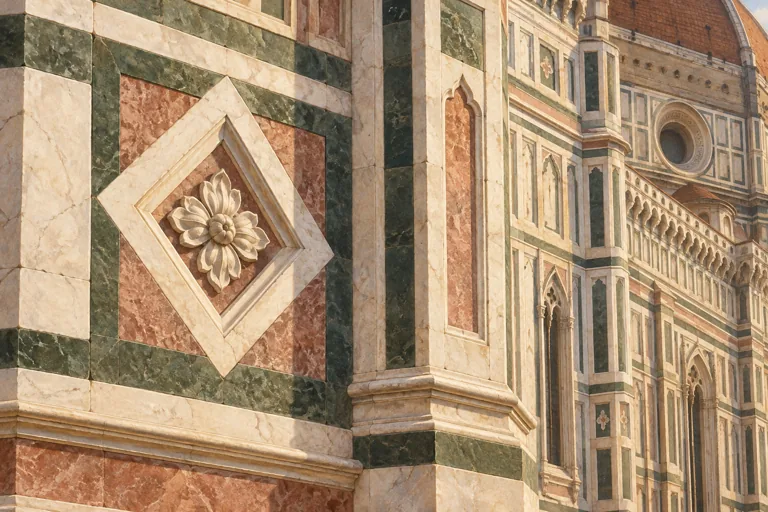
Our guide to Florence’s colored marble provides another way to observe the surrounding complex. Keep the pavement clear and avoid turning a close-up photograph into a prolonged obstruction. The square is a shared space, and its ordinary movement is part of the context in which monumental entrances are encountered.
Give the originals a different kind of attention
The Opera’s account of the restored Andrea Pisano door explains the museum setting of the restored originals. It is an archive notice, not a current offer of that guided event. Its conservation story helps explain why outdoor exposure and museum display cannot be treated as interchangeable conditions.
In the museum, select one panel rather than trying to decipher the entire door immediately. Follow the largest forms first, then look at smaller figures and the transitions between shallow and deeper carving. Ask how the image creates a sense of space. The answer may involve overlapping forms, changes in scale or different depths, but check the label before identifying a specific narrative detail.
Do not make the copy a lesser kind of visit
An original object carries its own material history, including wear and conservation. A copy can help preserve the architectural relationship that would otherwise be interrupted by removing that object. These are different values. You can appreciate a replacement’s role without claiming that it possesses the original’s age, surface or making history.
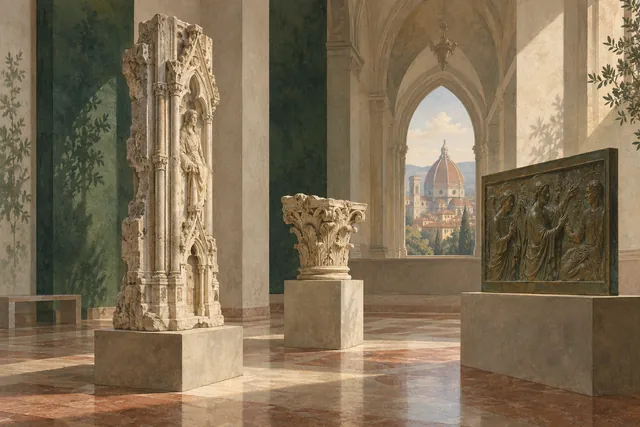
Try keeping two brief notes: “What the setting taught me” and “What the material taught me.” This avoids treating the museum as merely a place to tick off the authentic version. Our Opera del Duomo Museum guide explores the broader relationship between the cathedral complex and objects brought inside for study and protection.
Check the Baptistery’s current restoration notice
When researched on 16 October 2026, the official Baptistery page stated that the vault mosaics were not visible because of restoration. The Opera’s January 2026 restoration update describes the continuing project. Do not book an ordinary interior visit on the assumption that you will see the complete mosaic ceiling shown in older photographs.
Any special restoration-site visit has its own conditions and availability; it should not be confused with standard admission. Consult the official ticket information for your date and exact route. Our cathedral and dome ticket guide is a starting point for separating the different monuments, while the operator remains the authority on current access.
Make one comparison you can remember
You might compare how the outdoor doorway meets the building with how a single original panel uses light and depth. That is a manageable visit with a clear question. If guided explanation would help, inspect the named inclusions in Florence’s Duomo experience collection; museum entry or a restoration visit should be stated explicitly rather than inferred from a general cathedral title.
On a later Rome visit, the Palatine Museum offers another opportunity to think about objects separated from their original settings. Florence’s doors make that relationship especially visible. Leaving with a better understanding of why an original is protected, and what a copy preserves in public space, is more rewarding than simply deciding which photograph looks most impressive.
Sources & further reading
Turn a good read into a great day.
Find a highly rated Florentine experience that brings these stories to life.
Explore related experiences →