What can you learn from the Opera del Duomo Museum?
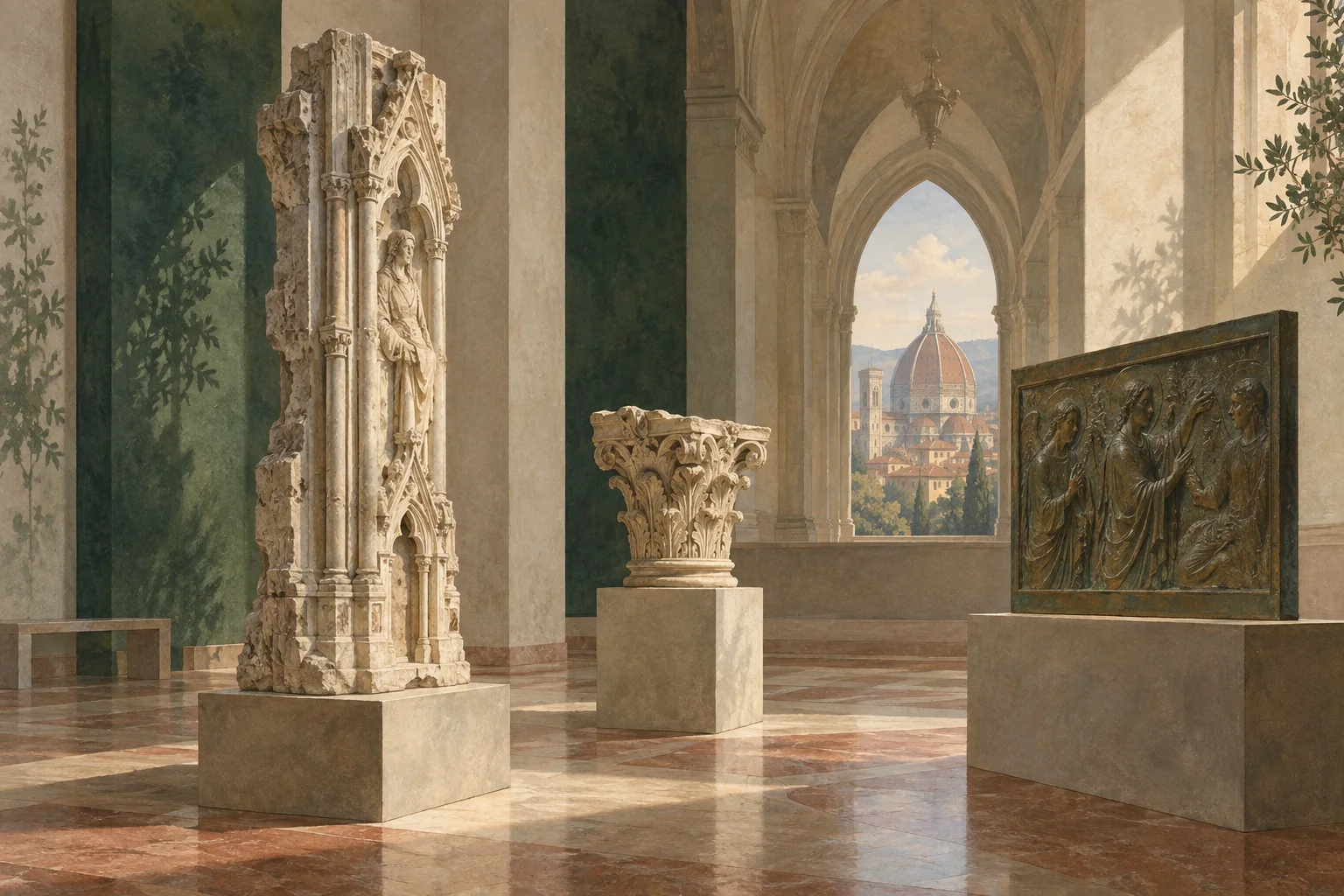
The Opera del Duomo Museum helps answer a question that the cathedral skyline cannot: how were individual works made to speak within a much larger religious building? Outside, height and distance dominate. In the museum, faces, surfaces and fragments become easier to study. You can move between the scale of a city monument and the scale of a carved hand without attempting a climb. That makes the museum a substantial visit in its own right, rather than a place to fill time between tower reservations.
The Opera’s official introduction describes a collection of original works created for the cathedral complex over centuries. Start with that relationship. A sculpture may be standing in front of you now, but the most interesting question may be where it originally stood. Our cathedral ticket guide helps separate the different parts of a Duomo visit before you make practical arrangements.
Discover that a famous building can have several appearances
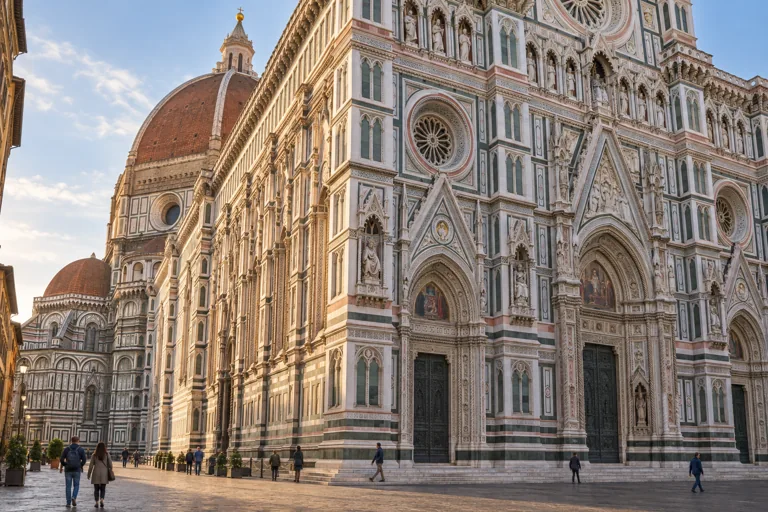
Visitors sometimes imagine that the cathedral has always looked like the building they see today. The Opera’s history of its art explains that the earlier facade associated with Arnolfo di Cambio was removed in 1587, while the present facade was completed in the nineteenth century. Surviving works therefore offer a way into an architectural appearance that is no longer outside in its original form.
Use that knowledge as a looking exercise. Find out which setting a work belonged to, then ask what changes when it is seen at museum distance. A face designed for a high position may read differently at eye level. A large gesture may become understandable when you imagine a viewer below. You do not need to reconstruct the complete old facade in your mind; one connection between object and setting is already a productive discovery.
Learn to compare instead of collecting famous names
The choir galleries offer a particularly useful opportunity. The museum’s description of the Sala delle Cantorie explains the relationship between the galleries made by Donatello and Luca della Robbia for the cathedral. Their musical subject provides a shared starting point, so you can compare movement, spacing and the treatment of figures without needing two separate art-history lectures.
Choose one small section from each. Which feels more orderly? Where does your eye stop, and where does it keep moving? Let your answer remain an observation rather than a competition with an official verdict. Looking at art is often more enjoyable when the aim is to explain what you noticed, not to guess which work you are supposed to prefer. Our Renaissance art guide for curious beginners develops this approach further.
Separate material, condition and expression
Give yourself three passes at a work that holds your attention. First notice its physical material and surface. Next look at condition: missing sections, joins or areas explained by the label. Finally consider the expression or action it presents. Keeping those questions separate stops a broken edge from becoming an invented dramatic gesture, or a later repair from being mistaken for an artist’s original choice.
Museum labels and displays are the starting point for those distinctions. Do not assume that everything pale is the same stone or that every dark surface is the same metal. If a detail puzzles you, write down the object title and the question rather than supplying an answer immediately. The museum becomes much less tiring when uncertainty is allowed to remain part of the visit.
Make the exterior a second chapter
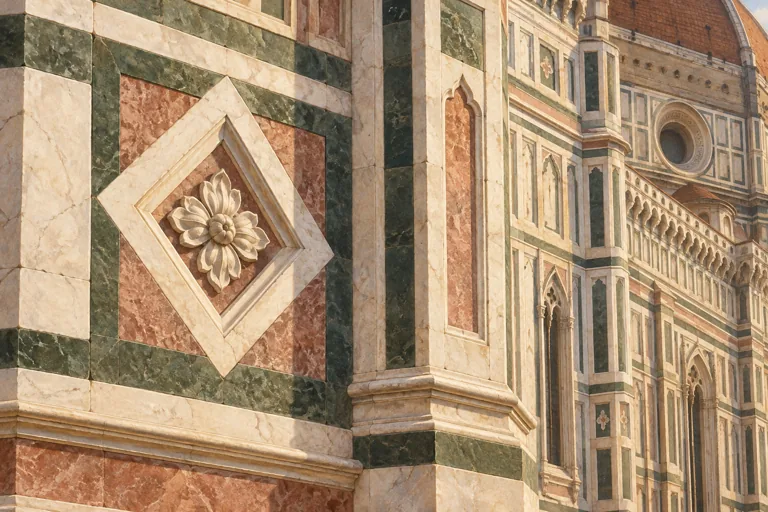
Afterwards, look at the cathedral complex again and notice how distance changes your attention. You may now be more interested in a portal, a band of decoration or the relationship between parts of the building. Our article on Florence Cathedral’s colored marble makes a useful companion, while the bell tower and dome comparison helps decide whether another physically demanding visit belongs on the same day.
Avoid scheduling the museum as a rushed gap between two fixed appointments. Choose a few works or themes and leave yourself time to change your mind. Check the current official opening calendar, ticket conditions and accessibility information before visiting; do not infer that every cathedral-complex activity is included in the same reservation. A museum visit and a tower climb ask different things of both your ticket and your energy.
Turn that curiosity into a practical choice
If you want a guide to connect the objects with their original settings, compare the Duomo and Renaissance experiences by their actual route and inclusions. A cathedral-focused tour does not necessarily enter the museum. Look for the part you care about in the itinerary and verify the meeting point and admission arrangements before booking.
For a wider Italian comparison, Rome Tour Hub’s Capitoline Museums approach asks similar questions about objects and context in a very different collection. The useful souvenir is a habit: when an artwork catches your eye, ask where it belonged before asking how quickly you can reach the next one.
Sources & further reading
Turn a good read into a great day.
Find a highly rated Florentine experience that brings these stories to life.
Explore related experiences →