Giotto’s Bell Tower or Brunelleschi’s Dome: Which Climb Suits You?
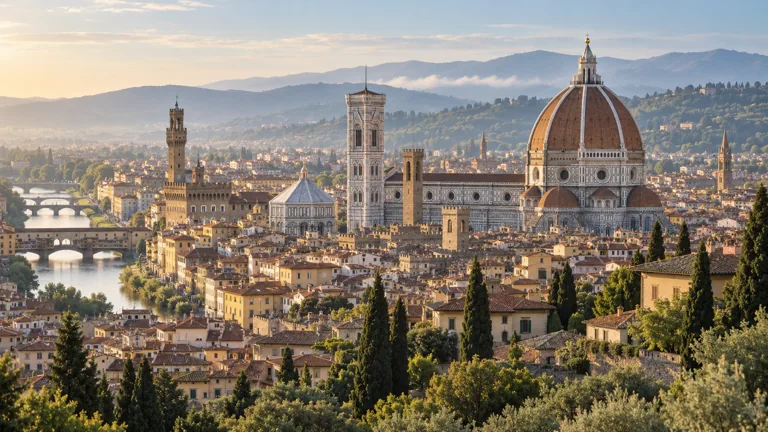
If you want the dome itself in your skyline view, Giotto’s Bell Tower is the more natural starting choice. If you want to experience the dome as a structure, including its interior route, Brunelleschi’s climb has the stronger claim. Neither is a simple upgrade on the other. They offer different relationships with the same cathedral complex, and both require substantial stair climbing. The best choice depends on what you want to notice, how you feel about enclosed spaces and how much physical effort belongs in this particular day.
Decide whether you want to see the dome or be inside it
From a neighboring tower, the dome remains part of the scene you are looking at. From the dome’s own summit, it cannot appear in front of you in the same way. That sounds obvious until a photograph persuades you to book the wrong viewpoint. Think about the experience behind your imagined picture: a panorama, a close encounter with construction, or a satisfying pause above the roofs.
The official dome description explains that its visitor route passes internal balconies with views of the decoration. Choose it when the relationship between interior space, painted surface and outer skyline interests you. Our article on how Brunelleschi built the dome provides background you can use before entering rather than trying to absorb everything on the stairs.
Compare the effort without reducing it to a number
The Opera lists 463 steps for the dome and 414 for the bell tower, with no lift for either ascent. The tower route passes several levels of loggias. Those numbers are useful, but a difference of 49 steps is not a reliable personal comfort rating. Stair shape, crowd movement, enclosure and your energy after several hours of walking can matter more than the arithmetic.
Read the operator’s and venue’s suitability guidance before booking. The official pages warn about the demands of these climbs, including enclosed spaces and height-related discomfort. A companion’s enthusiasm is not a substitute for your own judgment. If someone in the group would prefer to remain at ground level, agree on a pleasant independent activity and a clear meeting point rather than treating the decision as a failed challenge.
Check the current view, not just an older photograph
When checked on 4 October 2026, the official bell-tower page carried a major-restoration notice: the top terrace remained accessible, but views could be partially reduced. Read that notice again close to your visit. An open monument and an entirely unobstructed panorama are different promises, and neither an older blog image nor an attractive booking thumbnail settles the question.
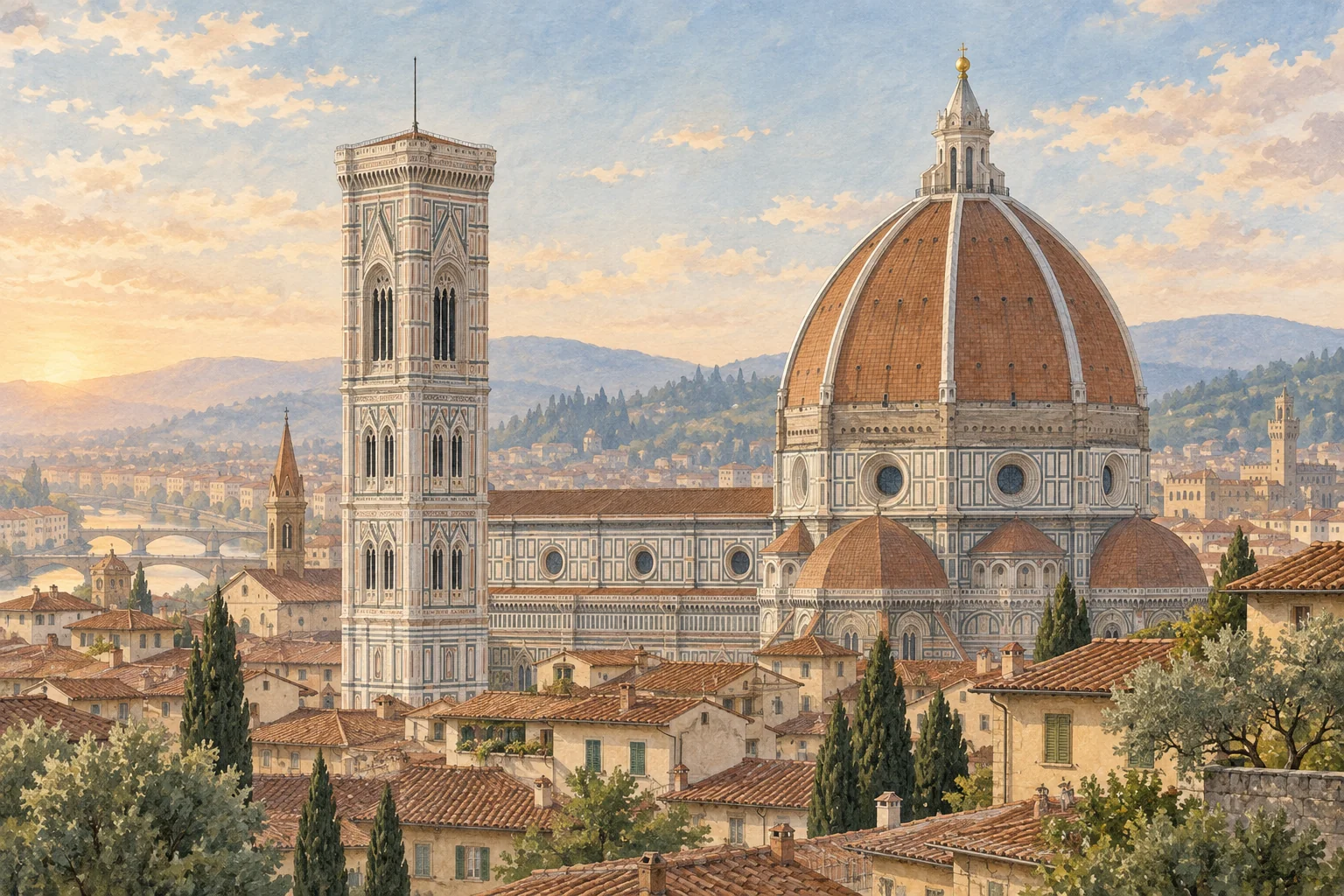
Our accompanying illustration is an architectural interpretation, not a report of current scaffolding or the exact view from a visitor platform. Use imagery to understand the relationship between the monuments, then use the institution’s live notices to assess conditions. If photography is your main purpose, this small distinction can make the difference between a satisfying visit and a preventable disappointment.
Match the pass and timing to the chosen climb
The Opera’s visit-planning guide distinguishes the Brunelleschi Pass, which includes the dome, from the Giotto Pass, which includes the bell tower but not the dome. Check the current pass contents and the exact reservation instructions attached to your purchase. The Opera also warns against unauthorized ticket resale: use its official shop for direct admission purchases and clarify the admission arrangements of any guided service before booking. Follow the time on your confirmation; do not assume a cathedral-complex ticket means you can join either staircase whenever convenient.
A guided service adds another layer of detail. Identify where you meet the guide, which entrance is used, what part is guided and whether climbing time is included in the advertised duration. Our cathedral ticket guide separates those basic admission questions. It is particularly useful when similar product titles conceal different combinations of monument access and guiding.
Leave room for the descent and the rest of Florence
Do not attach a distant, nonrefundable museum reservation immediately to the end of a climb. Allow for arrival procedures, any required bag storage, the descent and a proper pause afterward. Both official monument pages direct visitors with specified bags to the complex’s luggage-storage service. Check the current rules before leaving your accommodation so that you are not solving a bag problem at your entry time.
You can compare relevant options in our Duomo collection, then keep the afternoon gentler in your Florence day plan with a neighborhood walk or an unhurried meal. Doing both climbs may suit someone with a particular architectural interest, but it is not a requirement for a complete visit. One ascent chosen for a clear reason usually leaves a better memory than a second one booked simply because it was available.
The same habit of separating neighboring attractions helps elsewhere in Italy. Rome Tour Hub’s guide to the Vatican Museums versus St Peter’s Basilica starts with what you want to experience, rather than assuming that visiting one automatically includes the other.
Sources & further reading
Turn a good read into a great day.
Find a highly rated Florentine experience that brings these stories to life.
Explore related experiences →