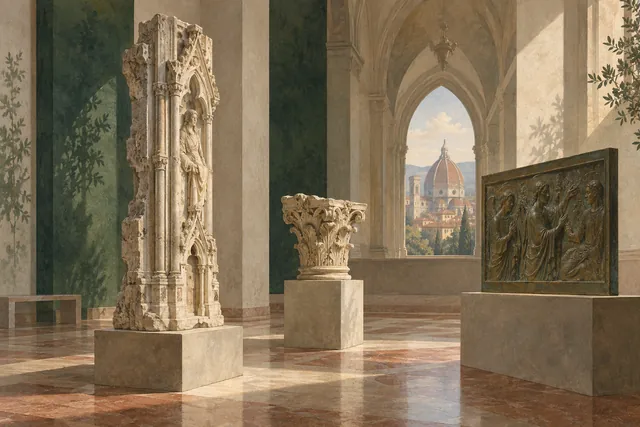
A stone bench and a dome in Florence’s Pazzi Chapel

Walk into the Pazzi Chapel at Santa Croce and let your eyes stay low for a moment. A stone bench follows the walls. It is a surprisingly direct introduction to a room famous for its dome. The people who commissioned it wanted a family chapel, and the Franciscans needed a chapter house where the friars could assemble. The bench places those meetings around the edges of a space that modern visitors often study by standing in the middle and looking up.
Find the room off the first cloister
Andrea de’ Pazzi commissioned the chapel after a fire affected this part of Santa Croce in 1423. Filippo Brunelleschi drew up the design, and work under his direction began in 1443. He died three years later. The Opera di Santa Croce’s chapel account traces the later stages, including the porch added after his death. As you approach, the columns and central arch of that porch give the chapel a public face toward the first cloister. They also introduce the first of several changes in scale.
Look at where you left the larger open space of the cloister and where you actually crossed into the room. The distance between those two moments lets a group gather, change direction or pause before entering. Santa Croce’s guide to the cloisters distinguishes this first court from the adjoining second one. The name associated with one cloister and the architect credited with a specific component are two different pieces of information. Use the chapel’s own description when identifying its porch.
Start with the square under the dome
Inside, look for a central volume that would fit inside a cube. It has a dome above it and a barrel-vaulted extension on either side. The arrangement means two things can be true of what you see. Your eye finds a strong center under the dome, while your body registers a wider room because of the two lateral wings. Compare the view from near the entrance with one slightly to the side, as visitor circulation permits. The stone lines will seem to draw the room into different shapes.
Gray pietra serena makes the arches and pilasters legible against light plaster. Pick a single upright and follow its line to the horizontal band above it. Then follow the band until another upright interrupts your eye. This is a practical way to understand a module, a repeated unit that relates several dimensions, without taking a single measurement. The guide to Brunelleschi’s cathedral dome introduces a much larger building problem by the same designer. Here you can take in the consequences of the geometry at the scale of a meeting room.
Distinguish the room’s two centers
The center of the geometry is overhead. The focus of devotion is in the smaller raised space containing the altar. Stand where you can see both and notice which direction each arrangement gives the body. A friar seated on the perimeter might face another member of the community across the floor. A person attending to the altar faces one end. A family’s religious commission and the practical requirements of a Franciscan assembly coexist in that change of orientation.
Look above the bench for the glazed terracotta roundels of the Apostles. The Opera attributes the set of twelve to Luca and Andrea della Robbia. Their scale suits the repeated bays of the walls. Farther into the altar space, stained glass depicts Saint Andrew, whose name also recalls Andrea de’ Pazzi. One detail belongs to a sequence that encircles a community. The other singles out a name and a particular place. Neither requires you to identify every figure before you can appreciate the difference.
Allow for the route through Santa Croce
Check the official visitor arrangements for opening, the visitor entrance in Largo Bargellini and any route changes. If you need wheelchair access from the basilica to the chapel, the Opera directs visitors out by the Largo Bargellini ramp and back into the complex through the Arnolfo di Cambio cloister on Piazza Santa Croce. Ask staff to indicate those points before setting off. A short distance on a floor plan can involve a change of entrance on the ground.
Our broader Santa Croce guide helps you decide how much time to spend in the basilica. For an architectural comparison on another day, San Lorenzo offers another opportunity to examine the relationship between a larger church and a more intimate room. For another family’s claim on church space, Bologna’s Bentivoglio Chapel offers a comparison across cities. Read the stops in Florence Renaissance itineraries if the chapel is particularly important to you. As you leave, look down again at the uninterrupted stretch of stone around the wall. What first looked like a border to the architecture has become a place you can imagine filled with people.
Sources & further reading
Turn a good read into a great day.
Find a highly rated Florentine experience that brings these stories to life.
Explore related experiences →