Seeing David at the Accademia: A More Thoughtful First Visit
Michelangelo’s David is so familiar in reproduction that meeting the sculpture can feel strangely unexpected. You know the outline, yet the scale, light and surrounding space are new. The most useful preparation is not to memorize a long list of facts. It is to arrive with enough time and attention to notice an actual object in a museum. Let the visit include anticipation, looking from different positions, and the quieter discoveries that lie beyond the celebrated figure.
Decide what kind of visit you want
Some travelers want a focused introduction to David and Michelangelo. Others want time with the Accademia’s painting, plaster models and musical instruments as well. Read the itinerary and duration of any guided option with that distinction in mind. A short tour may be an excellent fit for one purpose and a frustrating fit for another. The exact meeting point, included admission and arrangement after the guided portion are more useful than an adjective such as “ultimate.”
Our art and museum collection groups reviewed experiences, and the short-visit collection helps when a compact itinerary is important. Compare the live price for your travelers, not simply the lowest headline amount. If you are booking independently, use the museum’s official visitor information. Whichever route you choose, save the confirmation and allow the required arrival and security time.
Let scale become the first lesson
When you reach David, pause before reaching for a camera. Notice how the body occupies the space and how your view changes as you move. Look at the relationship between the head, hands and stance. You can ask what the figure seems to be attending to without pretending that a personal response is a definitive historical explanation. A guide or museum text can then supply context against which to test what you noticed.
Try looking from one side and then another, while respecting barriers and other visitors. Sculpture makes particular sense through movement. A photograph usually fixes one angle, but a three-dimensional object offers changing alignments and shadows. This is a chance to experience something a screen cannot fully reproduce. You may find that an apparently familiar work becomes less familiar, and more interesting, when you stop trying to match the image already in your head.
Give the surrounding works a chance
The official collection overview makes clear that the museum is not a single-object venue. It includes sculpture by Michelangelo, early Italian painting, plaster casts and models, and musical instruments connected with the Medici and Lorraine courts. Choose one additional area that genuinely interests you. A change of medium can refresh attention: after marble, look at painted color; after a finished figure, consider the role of a model or a working study.
The museum map identifies the Gallery of the Prisoners, the David tribune and other collection areas. Use it to make a coherent route rather than doubling back every time something catches your eye. You do not need to give equal time to every room. A thoughtful visit can be selective, provided the selection is yours rather than the accidental result of following the largest group through the building.
Bring practical questions into the plan
Check current access arrangements, permitted belongings and the museum’s opening notices. If you need a step-free route, ask about the route you will actually follow and any temporary limitations. A family visit needs its own pacing: give younger travelers one detail to find and a clear idea of when the visit will finish. A tired child does not usually become more interested because an adult has announced that an object is very important.
For a group with mixed interests, agree on a meeting place and a manageable amount of independent looking if the venue and tour arrangement allow it. One person may want every label, another may respond primarily to form. Both are legitimate ways into art. The aim is to make room for attention without turning a shared holiday into a negotiation beside every display case.
Continue the conversation outside
After the museum, choose a calm pause before the next attraction. Ask each person which detail surprised them, rather than whether they “liked” the entire visit. A specific observation gives you something to remember and something to discuss. You might later explore how different public spaces frame sculpture, or compare the experience with a guided walk through Piazza della Signoria. Florence’s art becomes more rewarding when each encounter leads to a question instead of merely another photograph.
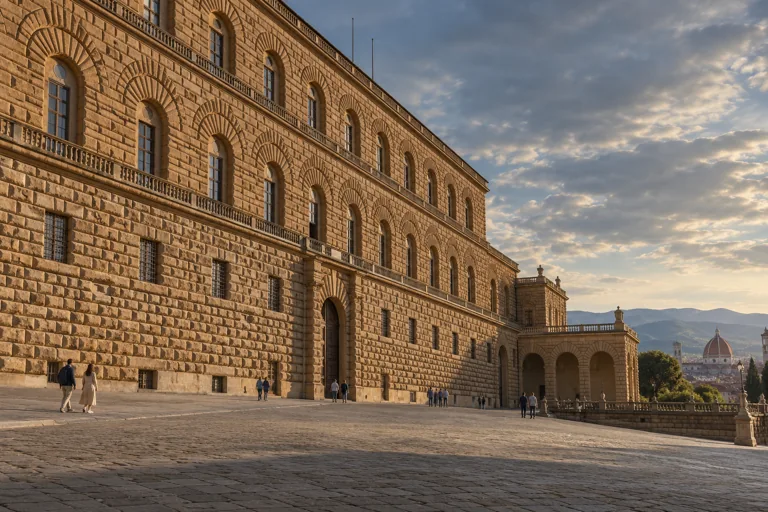
For another perspective, continue with Pitti Palace: More Than a Medici Address. It connects this visit with a different part of Florence and can help you choose what to give your time to next.
Sources & further reading
Turn a good read into a great day.
Find a highly rated Florentine experience that brings these stories to life.
Explore related experiences →