Pitti Palace: More Than a Medici Address
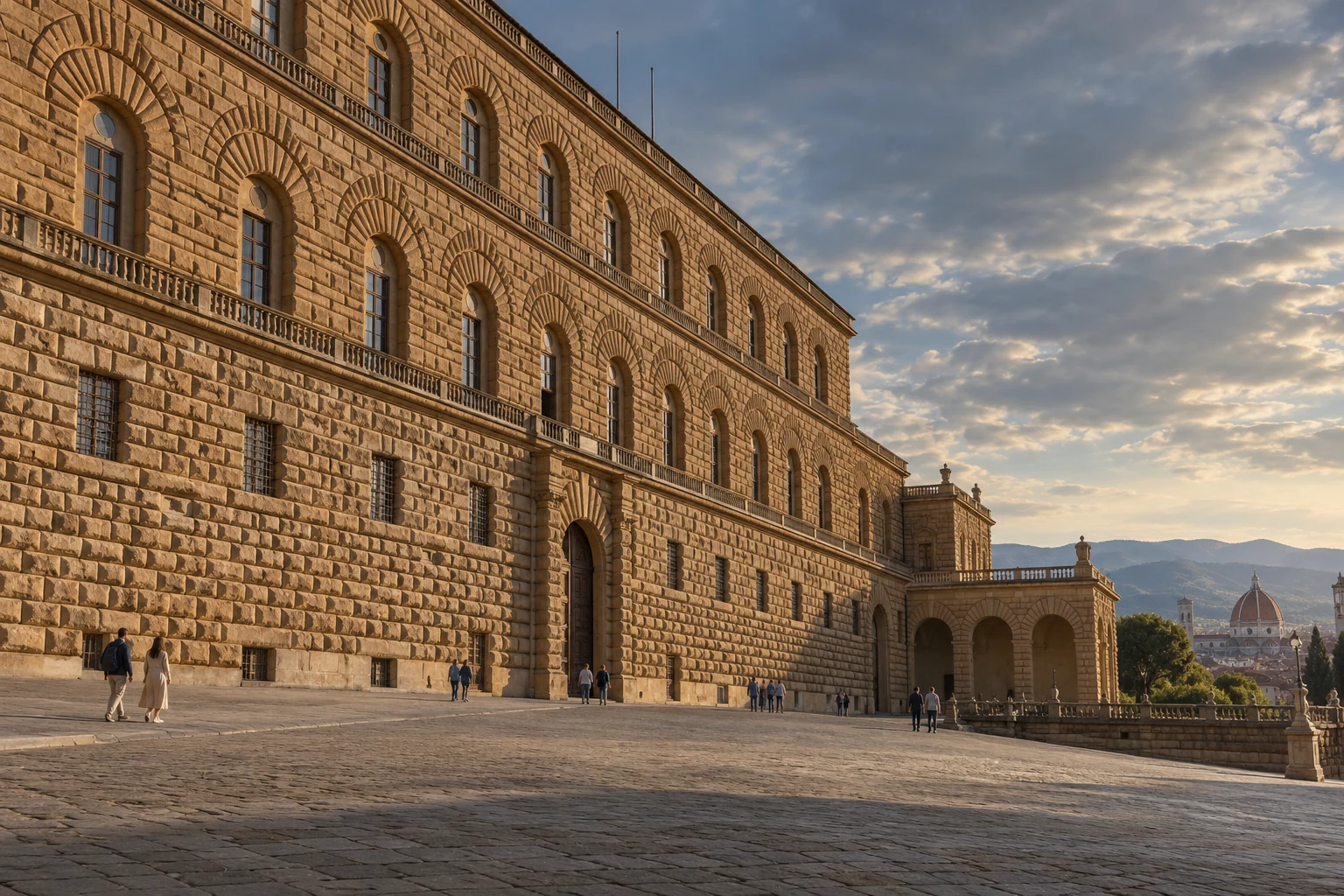
Pitti Palace announces itself before you know much about it. The heavy stone facade and broad sloping square suggest an institution built to be noticed. It can be tempting to summarize the place as “the Medici palace” and hurry inside. A more useful starting point is that Pitti served different owners and ruling families over time, and now contains several collections. Its story is therefore about changing uses as much as the power associated with one famous name.
Read the exterior as an introduction
Stand far enough back to see the repeated windows and the weight of the rusticated stone. Compare the scale of the doorway with a person approaching it. This is a simple architectural exercise, but it helps you register how the building presents itself. You do not need to decide exactly what its first patron intended in every detail. Begin with what the facade makes visible: repetition, mass, hierarchy and the relationship between a private residence and the public space in front.
The palace retains the name of Luca Pitti, whose family began its construction in the fifteenth century. Cosimo I de’ Medici and Eleonora of Toledo acquired it in 1550, and later the Habsburg-Lorraine and Savoy dynasties also used it. Those changes matter when you encounter interiors or objects from different periods. A historic palace is rarely a perfectly preserved snapshot of the moment suggested by its most familiar label.
Choose a collection before choosing a route
The official museum information identifies several collections within the palace, including the Palatine Gallery, decorative arts, modern art, costume and fashion, and other spaces. Check what is open for your date, as individual rooms or collections may have temporary restrictions. Decide which subject genuinely interests you most. “Seeing Pitti” can mean a focused art visit, an exploration of interiors or a broader day that also includes Boboli Gardens.
Our Florence art experiences include guided options, but read each product’s actual route. A title mentioning palace and gardens does not automatically promise every gallery. Check duration, admission inclusions and whether part of the visit is independent. If you are going on your own, the official museum map and notices are better planning tools than an old photograph of a room you hope to find unchanged.
Let the room compete with the painting
In a palace setting, a painting may share your attention with furnishings, frames, wall decoration and the architecture itself. Instead of treating those surroundings as visual clutter, ask how they affect your experience. Does a work feel different when it is part of a dense decorative setting rather than isolated against a plain wall? Where does your eye go first? The question helps you notice the display as a historical and curatorial choice.
Try studying one room in three passes. First register its overall mood and proportions. Then choose one object to examine closely. Finally look back at the room and see whether that object changes your understanding of the whole. This approach gives depth to a manageable visit. It also reduces the urge to photograph every surface simply because there is a great deal to see.
Add Boboli with realistic expectations
The gardens are a natural companion to the palace, but they involve slopes, changing weather and a different kind of energy. Check the current ticket combinations and opening arrangements rather than assuming admission transfers automatically between spaces. Our Boboli guide explains how to choose a comfortable route. You can appreciate the relationship between palace and garden without trying to exhaust both in one continuous session.
For another way to approach the collection, use our guide to looking at Renaissance art. Try one of its observation exercises in a single room, then compare the result with your experience of another collection. A thoughtfully chosen visit leaves room for differences in display, scale and atmosphere to become visible, rather than reducing museums to a competition for the largest number of famous names.
Give the ending some breathing room
Leave time to step back into the square and look again at the facade. The exterior will probably feel different after the interiors: less like a single imposing wall, more like the outer boundary of many rooms and stories. That changed perception is a satisfying measure of a museum visit. Finish with a pause in Oltrarno rather than an immediate sprint to the next appointment, and let the palace become part of your memory at a human pace.
For another perspective, continue with How Should You Spend One Day in Florence?. It connects this visit with a different part of Florence and can help you choose what to give your time to next.
Sources & further reading
Turn a good read into a great day.
Find a highly rated Florentine experience that brings these stories to life.
Explore related experiences →